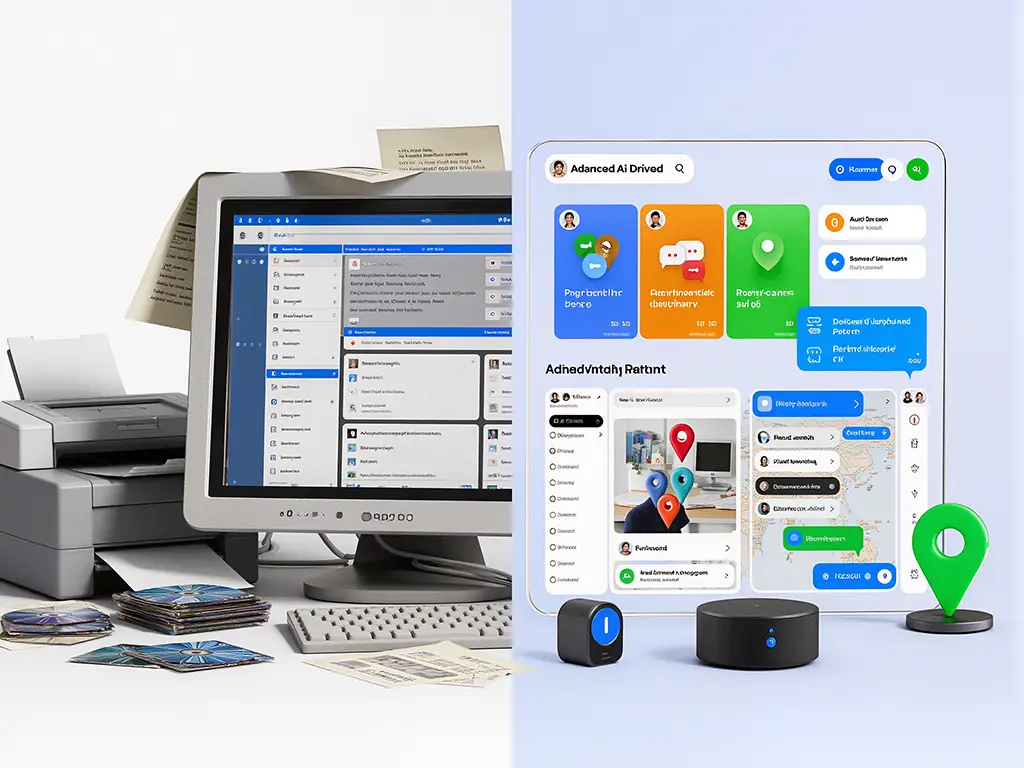

Most websites were built for a world that no longer exists.
A world where users clicked links, scanned pages, and did the work themselves. A world where search engines ranked documents, not answers. A world where visibility meant traffic.
That world is ending.
Today, users ask questions. Assistants respond. Agents reason. Search engines summarise. And websites that cannot participate in that conversation are quietly excluded.
If your website cannot be interrogated, summarised, or reasoned over, it is not just underperforming. It is dead weight.
Before: Websites That Wait to Be Clicked
Traditional websites were designed as destinations.
You published pages. You optimised keywords. You waited for someone to arrive, read, and decide.
This model assumed three things:
- Users would visit your site directly
- Search engines would send traffic to your pages
- Meaning lived in individual documents
As long as your pages ranked and loaded quickly, you were “discoverable.”
But even at its peak, this approach was fragile.
Content was siloed. Context was implicit. Answers were buried inside paragraphs written for humans, not machines.
Your website could display information, but it could not explain itself.
It could not answer follow-up questions.
It could not adapt responses based on intent.
It could not be reasoned over.
When users wanted clarity, they skimmed. When search engines wanted relevance, they guessed.
And now, neither is enough.
The Cost of Passive Content
Passive websites rely on interpretation.
They assume the reader will connect the dots.
They assume the crawler will infer structure.
They assume intent is obvious.
AI systems do not work that way.
If meaning is not explicit, it may as well not exist.
If relationships are not defined, they cannot be used.
If answers are not extractable, they will be ignored.
This is why many “high-traffic” sites are now invisible in AI-generated answers, overviews, and agent workflows.
They were built to be read, not understood.
After: Websites That Respond, Explain, and Reason
AI-native discovery changes the role of a website.
Your site is no longer just a destination. It is a knowledge source.
It must respond to questions from:
- Users typing natural language queries
- Search engines generating summaries
- Assistants selecting authoritative answers
- Autonomous agents evaluating options
In this world, visibility is not about ranking pages.
It is about being answerable.
An AI-ready website can be interrogated.
It can be asked:
- What do you do?
- Who is this for?
- How is this different?
- When should this be used?
- Why does this matter?
And it can respond clearly, consistently, and confidently.
What “Answerable” Really Means
An answerable website does not rely on a single blog post or landing page.
It exposes its logic.
Key concepts are defined.
Entities are consistent.
Relationships are explicit.
Information is structured so it can be:
- Summarised without losing meaning
- Compared against alternatives
- Referenced across contexts
- Reused in AI responses
Instead of long, vague explanations, it provides clear, atomic answers that can be assembled dynamically.
This is why AI systems favour some sites over others.
Not because they are newer.
But because they are intelligible.
From Pages to Knowledge
AI websites are not page-centric. They are knowledge-centric.
A page is just one expression of underlying understanding.
When an assistant summarises your offering, it is not quoting your homepage.
It is reconstructing meaning from signals.
If those signals are weak, fragmented, or contradictory, your site is excluded.
If they are strong, structured, and coherent, your site becomes a source.
This is the difference between being crawled and being consulted.
Bridge: How to Make Your Website Answer Questions
The shift from passive to answerable does not require starting over.
It requires rethinking how meaning is expressed.
The bridge is built from three disciplines working together: content strategy, structure, and AI-aware optimisation.
1. Write for Questions, Not Pages
Most websites are organised around what the business wants to say.
AI discovery is organised around what users want to know.
Start by identifying the real questions your audience asks:
- What problem does this solve?
- Is this right for my situation?
- How does this compare to alternatives?
- What happens if I do nothing?
Then answer those questions directly.
Not once.
But consistently, across your site, using the same language and definitions.
This consistency is what allows AI systems to trust and reuse your content.
2. Make Meaning Explicit
Implicit knowledge does not survive AI interpretation.
If something matters, state it.
If two concepts are related, connect them.
If a term is important, define it.
Use clear headings, structured lists, and concise explanations.
Avoid cleverness. Optimise for clarity.
This is not about “dumbing down” content.
It is about removing ambiguity.
3. Structure for Reasoning
AI systems do not just retrieve text. They reason over it.
They look for:
- Cause and effect
- Comparisons
- Criteria and outcomes
- Evidence and conclusions
Your content should reflect this logic.
Explain why, not just what.
Show trade-offs.
Clarify when something applies and when it does not.
This makes your site usable in decision-making contexts, not just informational ones.
4. Optimise for AI Discovery, Not Just SEO
Traditional SEO focuses on keywords and links.
AI discovery focuses on comprehension.
This includes:
- Consistent terminology
- Clear topical boundaries
- Logical internal linking
- Structured data where appropriate
It also means auditing how your site appears when summarised or paraphrased.
If the summary is vague, your content is too.
If the assistant hesitates, your positioning is unclear.
This is why many organisations now start with an AI Discovery Audit before investing in more content.
The Real Risk of Doing Nothing
The biggest misconception is that this shift only affects “AI companies” or “tech brands.”
In reality, it affects everyone.
If your customers use AI to research, compare, or decide, your website must be legible to AI.
Otherwise, you are not considered.
You do not lose traffic.
You lose relevance.
Your competitors do not need better products.
They just need clearer answers.
Conclusion: From Dead Weight to Decision Engine
Your website is either part of the answer ecosystem or it is not.
There is no middle ground.
Old websites wait to be clicked.
AI-ready websites respond.
They explain themselves. They adapt to questions. They participate in reasoning.
If your site cannot be interrogated, summarised, or reasoned over, it is invisible where it matters most.
The good news is that this is fixable.
With the right structure, clarity, and intent, your website can become a trusted source in an AI-driven world.
Not just something people visit.
But something AI systems rely on.