Search is changing fast. People still “Google it”, but now they also ask AI assistants, AI search experiences, and chat-style engines to summarize the web for them. The result is a new visibility battle: not just ranking on page one, but being selected, quoted, and cited inside AI-generated answers.
That is where Generative Engine Optimization, or GEO, comes in. GEO is the practice of shaping your content, technical signals, and brand footprint so generative systems can confidently understand it, validate it, and use it as a source in answers. Done well, GEO can increase qualified traffic, improve brand recall, and position you as the “default” expert AI engines reach for.
This guide shows you how to use GEO effectively, using a simple flow: Problem : Insight : Reframe : Action. You’ll leave with a repeatable playbook you can apply to new and existing content.
The problem: Traditional SEO doesn’t guarantee AI visibility
Classic SEO asks, “How do we rank?” GEO asks, “How do we get used?” That’s a big difference.
In a generative answer, the engine typically synthesizes multiple sources into one response. Even if you rank well, you might not be cited. Even worse, your idea might be used without your brand being mentioned, if your signals are unclear or your authority is not obvious.
Why this happens is simple. AI systems are trying to reduce risk. They prefer content that is easy to parse, consistent with other reputable sources, and backed by strong trust indicators. They also prefer content that cleanly answers the user’s intent, without forcing the model to “guess” what you meant.
So if your content is vague, poorly structured, thin on evidence, or missing clear entity context, you can lose out, even with strong traditional SEO.
Key insight: Generative engines reward clarity, structure, and confidence
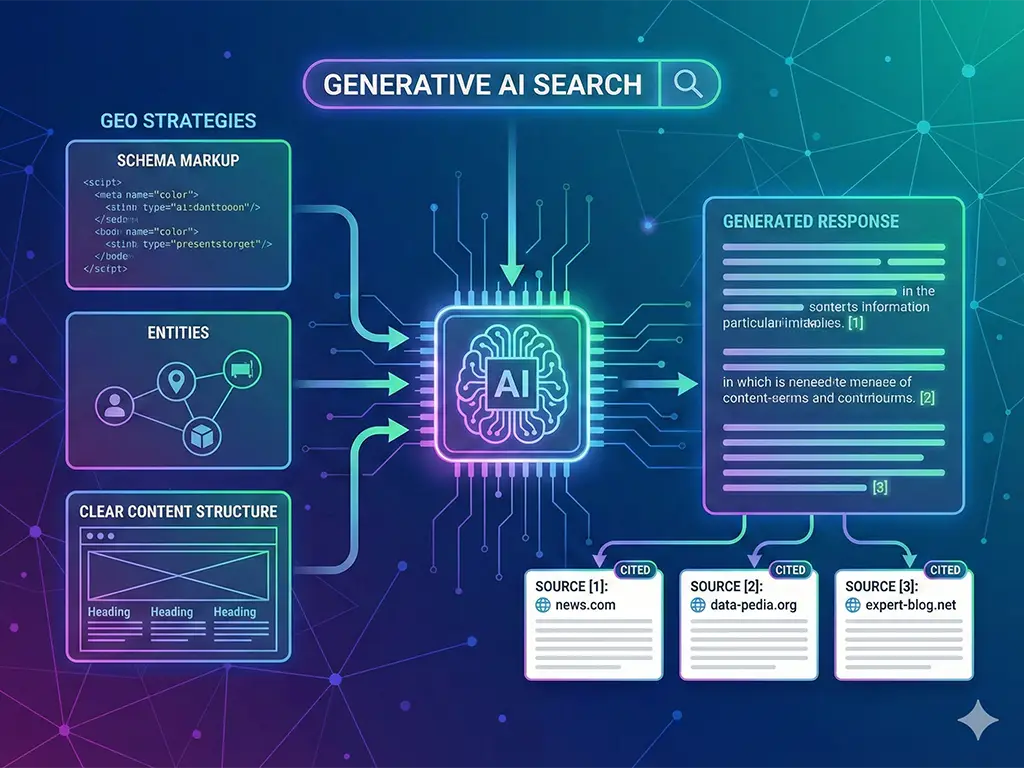
Most AI search experiences are grounded in web results. That grounding layer is crucial. It means GEO is not about “tricking” AI. It is about making your content easier to retrieve, safer to cite, and faster to validate.
From a site-owner perspective, Google explains that AI search features may include links for users to explore the web and learn more, and it provides guidance on how to approach your content’s inclusion in these experiences via Search Central documentation.
Similarly, Microsoft positions Copilot-style search experiences as summarized answers with cited sources. In practice, this means your best path to visibility is to become the kind of page an AI engine is comfortable citing.
There are three big levers that drive that comfort.
- Retrievability: Can the engine find your page for the right queries and entities?
- Interpretability: Can it quickly understand the claims, definitions, steps, and outcomes?
- Credibility: Does your content demonstrate expertise and match what trusted sources say, while adding unique value?
Reframe GEO: Stop writing “articles”. Start building “answer assets”.
Most websites publish content as if humans are the only readers. GEO works better when you treat each page as an answer asset with a clear job to do.
Ask yourself, “If an AI assistant had to quote one paragraph from this page, which paragraph would it choose?” If you cannot answer that instantly, your page is probably not GEO-ready.
An answer asset is designed to be lifted safely. It includes tight definitions, specific steps, constrained claims, and supporting context. It is written for humans, but structured for machines.
Here is a practical mental model. Your page should contain:
- A crisp claim: What is true, in one sentence?
- A bounded scope: When is it true, and when is it not?
- A method: How to do it, step by step.
- A proof layer: Links to authoritative references, data, standards, or documentation.
- An outcome: What changes when the reader applies it?
A GEO playbook you can apply today
1) Start with intent clusters, not keywords
GEO still benefits from keyword research, but the unit of work is broader: intent clusters. Generative engines answer tasks, not terms.
Build clusters around:
- Definition intent: “What is GEO?”, “How does GEO differ from SEO?”
- Process intent: “How to do GEO”, “GEO checklist”, “GEO strategy for B2B”
- Comparison intent: “GEO vs AEO vs SEO”, “best GEO tools”
- Troubleshooting intent: “Why am I not cited in AI answers?”
- Decision intent: “Hire a GEO agency”, “GEO audit”
For each cluster, create one primary page that fully answers the job, plus supporting pages that go deeper on sub-questions. Then interlink them deliberately.
Tip: Your internal link anchors should be descriptive. “Learn more about schema markup” beats “click here”. Include at least one contextual internal link per major section, for example Find out more about Schema Implementation.
2) Use an “answer-first” structure that AI can lift
AI engines love predictable structure. It reduces ambiguity. Use this layout pattern for GEO-critical pages:
- Intro: Say what the reader will get, in plain language.
- Direct answer paragraph: 40 to 80 words summarizing the core answer.
- Scaffold headings: Turn common questions into H2s and H3s.
- Step-by-step lists: Use ordered lists for processes and checklists.
- Definitions and constraints: Clearly label what something is, and what it is not.
This is not about “writing for robots”. It’s about making your expertise extractable without losing meaning.
Example: If your topic is “GEO auditing”, include a short list like:
- Identify where your brand appears in AI answers today.
- Map those answers to the pages being cited.
- Fix content gaps and unclear entity signals.
- Add structured data where it improves interpretation.
- Measure citation lift and refine content modules.
3) Write with entity clarity, not cleverness
Generative engines reason in entities: organizations, people, products, concepts, places. GEO improves when you make those entities explicit.
- Use the full entity name early: “Interon is a web design and AI discoverability studio…”
- Use consistent naming across the site, not variations that confuse association.
- Link to definitive references when appropriate, such as standards bodies, platform documentation, or official tools.
Also, reduce pronoun ambiguity. “This improves performance” is weaker than “This improves citation likelihood in AI answers because the page becomes easier to validate.”
4) Build a proof layer with authoritative references
AI systems prioritize safety and quality. Your job is to reduce uncertainty. A proof layer is where you earn trust.
Practical ways to do this:
- Cite platform documentation: For example, reference Google Search Central pages about structured data and AI search features, or Microsoft pages describing Copilot Search.
- Use standards: When discussing structured data, reference Schema.org and implement according to search engine guidance.
- Use precise language: Avoid overclaiming. Prefer “can” and “may” when outcomes depend on multiple factors.
Don’t drown the page in citations. Add references where they reduce risk and strengthen decision-making, especially for definitions, policies, and technical behavior.
5) Make structured data do real work
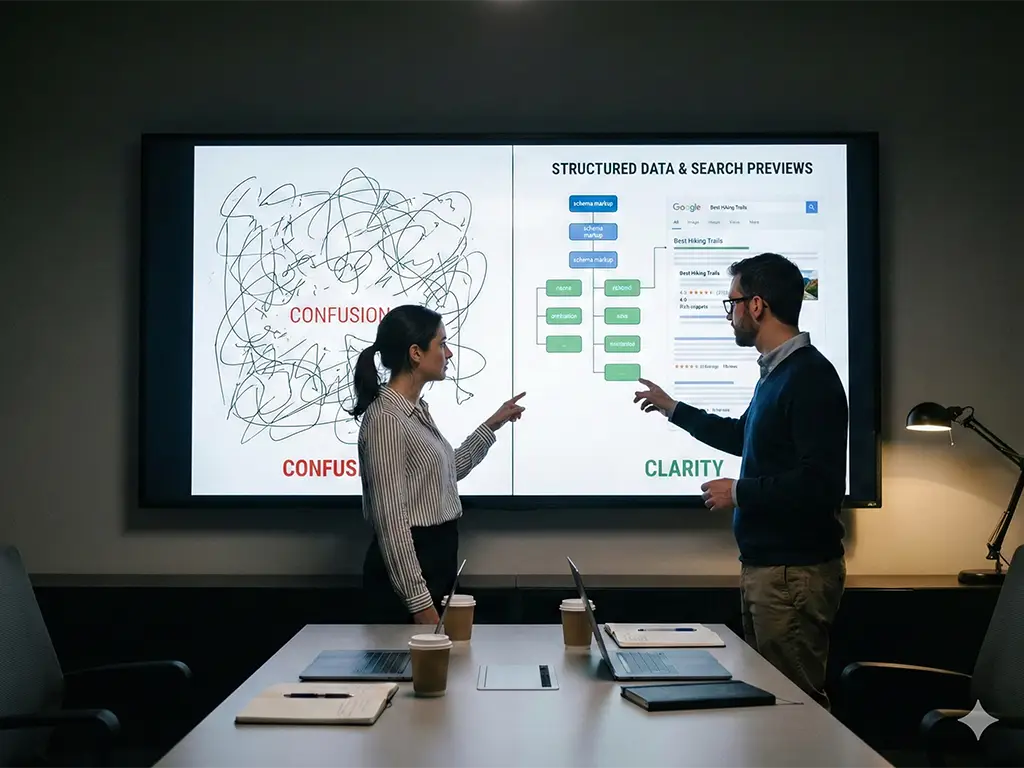
Schema markup is not a magic button, but it is a powerful clarity tool. Google’s structured data guidance is clear that structured data can enable eligibility for certain search features, but does not guarantee them. That’s fine. In GEO, the goal is interpretability and entity disambiguation.
Focus on schema types that match your content and business reality:
- Organization and LocalBusiness for brand identity and trust signals.
- Person for authors, especially when expertise matters.
- Article with clear author and publisher relationships.
- FAQPage only when the content genuinely matches FAQ intent and follows guidelines.
- Product or Service where applicable, with accurate properties.
Key GEO principle: Only mark up what is visible and true. Search engines explicitly warn that misleading or incorrect structured data can harm eligibility.
If you want Interon to review your schema for both SEO and AI interpretability, go to "FREE AUDIT" and run your home page audit
6) Create “quotable blocks” that are safe to reuse
To get cited, you must be quotable. Build short blocks that an AI can confidently reuse without context collapse:
- Definition blocks: “Generative Engine Optimization (GEO) is…”
- Criteria blocks: “A page is GEO-ready when…”
- Checklist blocks: “Do these five things before publishing…”
- Decision blocks: “Use approach A when… Use approach B when…”
Each block should be self-contained, with minimal pronouns and clear nouns. Think of it as “copy-paste safe for meaning”.
7) Update content for freshness and revision clarity
Generative engines often prefer up-to-date pages for fast-changing topics. You can help by:
- Adding a visible “Last updated” date when you materially revise content.
- Updating screenshots, definitions, and platform references as features evolve.
- Keeping URLs stable so accumulated signals are not lost.
Important: Don’t fake freshness. Actually revise the content. AI engines and users can tell when “updated” does not match substance.
8) Measure GEO with citation tracking, not just rankings
Rankings still matter, but GEO needs additional measurement. Track:
- AI citation presence: Are you being cited in AI answers for target intents?
- Citation share: How often are you cited compared to competitors?
- Query-to-page mapping: Which pages earn citations for which questions?
- Conversion quality: Do AI-referred visits engage and convert?
A simple workflow is to maintain a monthly “AI visibility log”: 20 to 50 queries you care about, checked across the AI search experiences your audience uses. Record whether you appear, what page is cited, and what content block seems to have been used. Then improve that block.
If you want a structured approach, start with an AI Discovery Audit that identifies gaps and quick wins.
Common GEO mistakes, and how to fix them
Mistake 1: Writing long intros that delay the answer
If your page takes 500 words to define the topic, an AI engine may skip it. Fix it by putting a direct answer in the first 150 to 200 words.
Mistake 2: Making claims without boundaries
“GEO guarantees traffic” is risky and likely to be ignored. Replace it with bounded claims: “GEO increases the likelihood of being cited when your content is relevant, well-structured, and trusted.”
Mistake 3: Thin content that repeats what everyone says
If your page adds no unique value, you become interchangeable. Add original frameworks, checklists, examples, or implementation steps that readers can apply.
Mistake 4: Ignoring technical accessibility
Slow pages, blocked crawling, messy rendering, and confusing navigation reduce retrievability. Technical SEO fundamentals still underpin GEO. Ensure key pages are crawlable, indexable, and fast.
Mistake 5: Treating schema as decoration
Schema should clarify meaning, not inflate it. Mark up what is visible, accurate, and aligned with guidelines. Then test using official tools where applicable.
A practical GEO checklist for every new page
- Intent: Is the page built around a clear question or task?
- Answer-first: Does the intro include a direct 40 to 80 word answer?
- Structure: Are headings phrased like the user’s questions?
- Quotable blocks: Are there definition, checklist, or criteria blocks?
- Entity clarity: Are key entities named and consistent across the site?
- Proof layer: Are authoritative references linked where they matter?
- Schema: Is structured data accurate and aligned with guidelines?
- Internal links: Are related pages linked contextually and descriptively?
- Experience: Is the page fast, readable, and easy to navigate?
- Measurement: Is citation tracking in place for target queries?
GEO is an operating system, not a tactic
Using GEO effectively is not about chasing every new AI feature. It’s about building content and web signals that are clear, trustworthy, and easy to reuse without distortion.
When you apply the GEO mindset, you stop publishing generic articles and start building answer assets. You make your expertise legible to humans and machines. And you create a compounding advantage: each strong page increases your brand’s chance of being the cited source that AI engines return to again and again.